Lee Ming-che: Taiwanese activist goes on trial in China
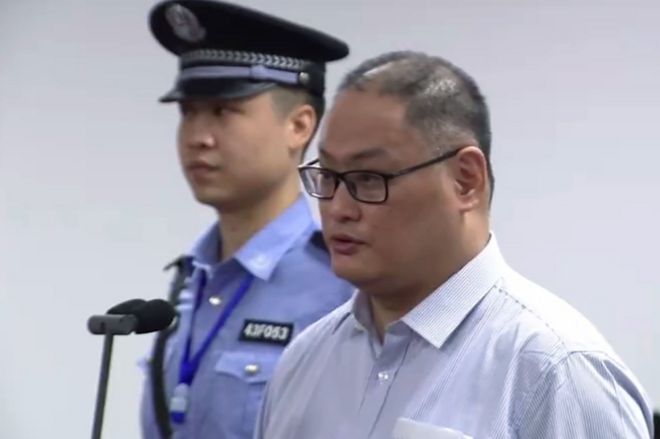
A Taiwanese pro-democracy activist has gone on trial in China accused of "subverting state power".
Chinese authorities say Lee Ming-che promoted multi-party rule in group messaging chats.
The 42-year-old activist went missing in China in March and was later revealed to have been detained.
Little information has been given by Chinese authorities, but the case has gripped Taiwan amid already strained relations with China.
His wife Lee Ching-yu, who has led calls for his release, is attending his trial in Hunan province. She had warned he may be pressured to make a confession against his will.
What happened to him?
Mr Lee, an NGO worker, is a well-known democracy and human rights activist in Taiwan.
On 19 March he travelled to the semi-autonomous Chinese territory of Macau, then moved on to the southern mainland province of Guangdong where he went missing.
His wife later held a press conference in Taiwan calling for answers from the Chinese government.
On 29 March, China announced Mr Lee had been detained for "pursuing activities harmful to national security". In May, authorities said he was suspected of "subverting state power", and that he was being held in Hunan province.
A Chinese activist, Peng Yuhua, is also on trial with Mr Lee on similar charges.
What is he accused of doing?
Prosecutors at the Yueyang Intermediate Court in Hunan province, which is posting live updates on the trial online, accused Mr Lee of "attacking Chinese society and encouraging multi-party rule".
They said he did this through an organisation called Plum Blossom Company set up with Mr Peng, and also through posts in a group chat with more than 2,000 members in the hugely popular messaging app WeChat.
Mr Lee was accused of using the medium to organise activities "inciting others to subvert state power" as well.
Mr Lee was seen in a clip recorded at the trial saying he had "no objection" to the charges.
He admitted that he had circulated and written articles that "attacked and wickedly smeared the Chinese government" and "promoted Western-style multi-party democracy" on various social media and messaging platforms.
Mr Lee's family and colleagues have said he did regularly exchange messages with friends in mainland China discussing democracy and China-Taiwan relations, but that he had done nothing wrong and only shared his experiences as an activist.
On Saturday, his wife told reporters: "Please forgive Lee Ming-che if you see him doing or saying something embarrassing in court under duress.
"That is just the result of the Chinese government skilfully extracting a 'guilty confession'," the CNA website (in Chinese) quoted her as saying.
How big is this case?
The case has strained relations between China and Taiwan, which Beijing considers a breakaway province to be reunited with the mainland one day.
It is being watched particularly closely in Taiwan, where many often travel to mainland China for work or holidays.
Taiwanese President Tsai Ing-wen has called on Chinese authorities to return Mr Lee safely, and to "not let this case be an impediment" to relations.
"China may perhaps see this as a small matter, but in reality, this is a huge cross-strait issue," she said in a statement (in Chinese) in April.
The spokesman of China's Taiwan Affairs Office, Ma Xiaoguang, previously the investigation into Mr Lee would be "handled in line with legal procedures".
Audience:
This article is written to the Western world to inform them of what is going on in China right now. It could also be aimed at Taiwan to help them keep up with the situation, since it is their man who has been imprisoned. It is clearly not aimed at China because it speaks openly about their corrupt government.
Writer's Bias:
The name of the writer of this article was not disclosed, which makes identifying their bias slightly harder. Nevertheless, there clearly is some bias here. They obviously consider the Chinese government to be fairly corrupt and mention that Mr. Lee will most likely be forced to make a false confession. They also interviewed Mr. Lee's family who insist that he did nothing wrong, which puts Mr. Lee in a positive light.
Publisher's Bias:
The BBC is a worldwide organization, and, since most of the world would associate the Chinese government with negative connotations, it makes sense that they do as well. As a rather liberal organization, they obviously are much more in favor of democracy and liberty than tightly-controlled conservative governments, which plays out in their bias here, since they clearly consider Mr. Lee to be the victim of the Chinese government's abuse.
Reader's Bias:
As I read this article, I found myself siding with the author and the BBC and very much saw Mr. Lee as the poor innocent victim. As someone who has heard a lot about the oppression that the Chinese government is capable of, I was negatively disposed towards them after reading only the first few sentences. As a Christian, I have heard lots about its persecution of the Church which also played a role in my bias here. Additionally, as a human, I am usually supportive of an underdog which also lead me to favor Mr. Lee
Purpose:
I think that the author is calling people to rise up behind Mr. Lee. By painting him in a positive light and as the underdog of the situation, this is bound to happen. Additionally, the author is trying to create awareness of the situation and to let Mr. Lee's family say their bit and defend their relative and husband. They are also trying to create awareness of the situation in China and how dangerous the government still is.
Opinion:
I think that the Chinese government should release Mr. Lee immediately. Not only has the poor man done nothing wrong, China is straining their relationship with Taiwan which could prove disastrous later. I think that if China refuses to release Mr. Lee soon, then the Taiwanese government or even the US government should get more involved and free him, despite the risk of negative consequences. I do not believe that any country should have the power to wrongfully arrest someone from another country and force them to make a false confession.
“Lee Ming-Che: Taiwanese Activist Goes on Trial in China.” BBC News, BBC, 11 Sept. 2017, www.bbc.com/news/world-asia-china-41222940.
Comments
Post a Comment